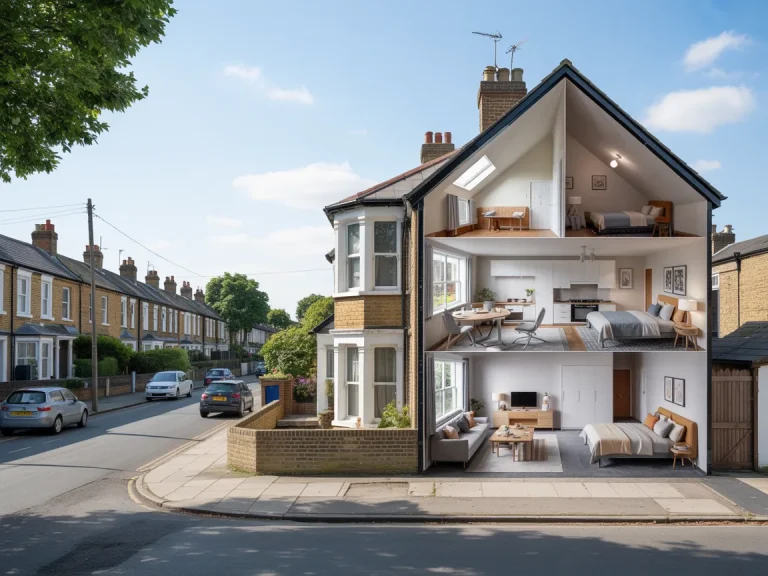
A House in Multiple Occupation, usually shortened to HMO, is a property occupied by people from more than one household who share facilities such as a kitchen, bathroom or toilet.
HMOs are a popular property investment strategy because a landlord can rent individual rooms to separate tenants rather than letting the whole property to one household.
However, HMOs are also subject to additional rules around licensing, property standards, management and, in some cases, planning permission.
For anyone considering buying or converting a property into a HMO, it is important to understand the difference between what legally makes a property a HMO, whether it needs a licence, and whether planning permission is required.
These are separate questions and the answer to one does not automatically determine the others.
What we cover on this page
What legally counts as a HMO?
In England, a property will generally be considered a HMO if:
At least three tenants live there
The tenants form more than one household
They share facilities such as a kitchen, bathroom or toilet
A household can be one person living alone or members of the same family living together.
For example, three unrelated professionals sharing a house would normally form three separate households.
A couple sharing with another unrelated person would usually represent two households.
A house occupied entirely by one family would not normally be a HMO simply because several adults live there.
The legal definition can be more detailed in certain circumstances, particularly with converted buildings and self-contained flats, so landlords should check the position for the individual property.
What is the difference between a small and large HMO?
The terminology can sometimes cause confusion because licensing rules and planning rules use different thresholds.
For mandatory HMO licensing in England, a property generally needs a licence where it is occupied by five or more people from two or more households who share facilities.
This is commonly referred to as a large HMO.
However, a property occupied by three or four unrelated tenants may still legally be a HMO even though it does not fall within mandatory national licensing.
Local councils can also introduce additional licensing schemes covering smaller HMOs, so landlords should never assume that a property does not need a licence simply because fewer than five people live there.
What is a HMO licence?
A HMO licence is issued by the local council and is designed to ensure that the property is suitable for the number of people living there and is being properly managed.
Mandatory licensing generally applies to HMOs occupied by five or more people from more than one household.
However, councils can introduce additional licensing requirements in their area.
This means a smaller HMO that would not require a licence under the national mandatory licensing rules may still require one locally.
Landlords should therefore check with the relevant council before buying, converting or letting a HMO.
The council may consider areas such as:
The number and size of bedrooms
Kitchen and bathroom facilities
Fire safety measures
Gas and electrical safety
Property management
Waste storage
The maximum number of occupants
Licences are normally granted for a specified number of occupants and households, so landlords also need to make sure the way the property is actually being used remains within the licence conditions.
A property may meet the legal definition of a HMO and require a licence, but that does not necessarily tell you whether planning permission is required.
Under the planning system in England, a small HMO occupied by up to six residents can generally fall within Use Class C4.
Larger HMOs with more than six residents normally fall outside the standard use classes and are treated as sui generis, meaning a use of their own.
Changing a normal dwelling within Use Class C3 into a small C4 HMO can sometimes be carried out under permitted development rights.
However, this is not always the case.
Some councils have introduced an Article 4 Direction, which removes this permitted development right in specified areas. Where an Article 4 Direction applies, planning permission may be required to change a normal house into a HMO even where there are six or fewer occupiers.
Local planning policy therefore needs to be checked before proceeding with a conversion.
One of the main attractions of a HMO is the potential to generate income from several individual rooms.
Instead of receiving one monthly rent for the whole property, the landlord may receive rent from each tenant separately.
For example, a traditional house might be let to one family under a single tenancy, whereas a HMO could contain several bedrooms let individually with tenants sharing communal facilities.
This can potentially produce a higher overall rental income, although the running costs can also be higher.
HMO landlords may need to budget for utilities, broadband, cleaning of communal areas, additional maintenance, licensing costs, management and more frequent tenant changes.
The gross rent should therefore not be considered in isolation.
Investors need to look at the net return after the additional costs of operating the HMO.
What types of property can become a HMO?
Many HMOs begin as conventional residential houses that are converted to accommodate several tenants.
Typical examples include larger terraced, semi-detached or detached houses where there is enough space to create suitable bedrooms and shared facilities.
However, not every property is suitable.
An investor needs to consider the size and layout of the building, local HMO standards, bedroom sizes, fire safety requirements, planning restrictions and tenant demand.
Some projects involve relatively straightforward alterations, while others may require significant refurbishment or reconfiguration.
If substantial work is required before the property can operate as a HMO, the initial funding may also be different from the long-term mortgage used once the conversion is complete.
What should you check before buying a potential HMO?
A property should not be assessed simply on whether enough bedrooms can physically fit inside it.
Before buying, investors should consider:
Whether the intended occupation would make the property a HMO
Whether a HMO licence is required
Whether the council operates additional licensing
Whether an Article 4 Direction applies
Whether planning permission is required
Local bedroom and amenity standards
Fire and safety requirements
Demand from the intended tenant market
Refurbishment or conversion costs
Expected rental income
How the completed property will be financed
Checking these points before committing to the purchase can help avoid discovering later that the intended HMO use is restricted or that additional works are required.
Who typically lives in HMOs?
HMOs can serve a wide range of tenant groups.
They are commonly associated with students, but many are occupied by working professionals or other people who prefer to rent a room rather than an entire property.
The target tenant market can influence the location, layout, facilities and standard of accommodation required.
A student HMO close to a university may operate differently from a professional house share near a major employment centre.
Landlords should therefore assess local demand rather than assuming that a HMO strategy will work equally well in every location.
HMO management responsibilities
Running a HMO can involve more management than a conventional single-household buy-to-let.
Several unrelated tenants are sharing the same property, so communal facilities and safety arrangements become particularly important.
Landlords may need to manage individual tenancies, room changes, communal areas, maintenance, utilities and compliance requirements.
There are also specific HMO management regulations covering matters such as safety, water supply, common areas, waste disposal and the landlord’s responsibilities.
This is one reason experienced HMO landlords often treat the property as a more active investment rather than a completely passive buy-to-let.
How are HMOs valued?
HMO valuations can also differ from standard residential property valuations.
Depending on the property and lender, a HMO may be valued using a traditional bricks-and-mortar approach based on comparable residential sales, or in some circumstances using an investment or commercial valuation that takes rental income into account.
The valuation method can materially affect the value accepted by a lender and therefore the amount an investor may be able to borrow.
We cover this separately in our guide to How Lenders Value HMOs.
How are HMOs financed?
HMO mortgages are more specialist than standard buy-to-let mortgages.
Lenders may consider the number of rooms, licensing and planning position, property valuation, rental income, borrower experience and whether the property is being purchased personally or through a limited company.
Lender appetite can also differ between smaller HMOs and larger or more complex properties.
Advocate Finance has a separate guide coveringHMO mortgages, including borrowing criteria, valuations, remortgaging and limited company applications.
If a property needs significant conversion work before it can operate as a HMO, short-term conversion or refurbishment finance may sometimes be required before refinancing onto a long-term HMO mortgage.
Is a HMO right for every property investor?
HMOs can provide strong rental income and an opportunity to make more efficient use of larger properties, but they also bring additional responsibilities.
Investors should consider the property, local demand, licensing, planning, refurbishment costs, running costs and finance before deciding whether the strategy is suitable.
The most important point is to investigate the intended HMO use before buying the property, rather than assuming that a conventional house can automatically be converted and let to multiple tenants.
How Advocate Finance can help
Advocate Finance specialises in property finance for landlords and investors, including HMO mortgages and funding for HMO conversion projects.
If you are considering purchasing an existing HMO, refinancing one, or buying a property that you intend to convert, we can help assess the finance options available.
If the property needs refurbishment or conversion before it is ready for a long-term mortgage, we can also discuss the funding options available for the purchase and works.
It may be. In England, a property will generally be a HMO where at least three tenants from more than one household live there and share facilities such as a kitchen, bathroom or toilet.
No. Mandatory licensing generally applies where five or more people from more than one household occupy the HMO. However, councils can operate additional licensing schemes that include smaller HMOs.
Potentially, but you need to check the planning, licensing and property requirements first. An Article 4 Direction may mean planning permission is required even for a smaller HMO.
No. A HMO normally involves tenants renting rooms and sharing facilities within one property. A Multi-Unit Freehold Block generally contains separate self-contained residential units held under one freehold title.
HMO finance is generally more specialist than standard buy-to-let because lenders may consider factors such as the number of tenants, licensing, planning, rental income and valuation method.

 Current Bank Base Rate: 4%

 01206 544333