01206 544333
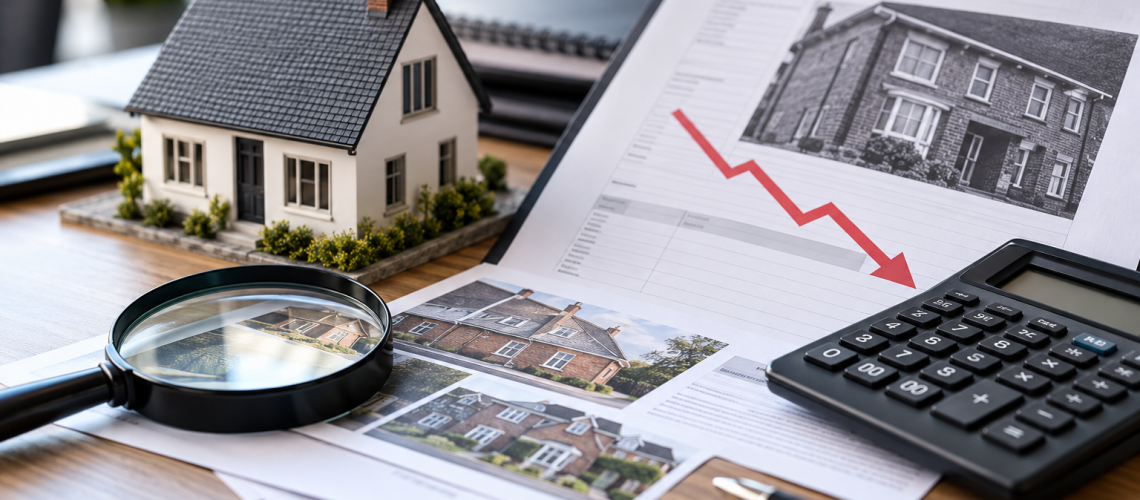
A property valuation coming in lower than expected can be frustrating, particularly when you have already agreed a purchase price or arranged finance based on a higher estimated value.
For property investors, landlords and business owners, a down valuation can affect the amount a lender is prepared to lend, the mortgage product available and the amount of cash needed to complete the transaction.
However, a lower valuation does not necessarily mean the deal has to stop.
Depending on the circumstances, you may be able to challenge the valuation, accept a lower loan amount, move to a different mortgage product, or consider another lender.
The first step is to understand how the lower valuation affects the loan-to-value, usually referred to as LTV.
.
What is a “Down Valuation”?
A down valuation happens when the lender’s valuer assesses the property at a lower figure than the borrower, seller or purchaser expected.
For example, you may agree to purchase a property for £300,000 but the mortgage valuation comes back at £290,000.
The lender will usually base its lending decision on the valuation figure it accepts, rather than simply using the agreed purchase price.
This can affect both the maximum loan available and the mortgage product you qualify for.
Down valuations can occur on buy-to-let properties, HMOs, multi-unit blocks, semi-commercial property, commercial property and refinances.
.
Why might a valuation come in lower?
The price somebody is prepared to pay for a property and the value accepted by a mortgage lender are not always the same.
A valuer will consider the property itself and the available market evidence before reaching a figure.
Factors may include:
- Recent sales of comparable properties
- Property condition
- Location
- Rental income
- Commercial lease terms
- Property type and construction
- Local demand
- Any unusual features affecting resale
For more specialist property, such as commercial, semi-commercial, HMO or multi-unit investments, the valuation can be more complex than simply comparing the property with another building nearby.
Rental income, lease arrangements, tenant quality and investment yields may also influence the valuation.
.
Asking prices are not sold prices
One of the most important points when challenging a valuation is the evidence being used.
An investor may find similar properties being advertised online at higher prices and assume this proves their property is worth more.
However, asking prices are not the same as completed sale prices.
A property advertised at £350,000 may ultimately sell for £320,000, or may not sell at all.
If you want to challenge a valuation, recent completed sales of genuine comparable properties are much stronger evidence than properties currently advertised on property portals.
The most useful sold comparables will usually be recent and similar in location, size, condition and property type.
.
Can you challenge a property valuation?
It may be possible to appeal or challenge a valuation, although the process will depend on the lender.
A challenge normally needs to be supported by clear evidence showing why the original figure may not accurately reflect the property’s market value.
Simply disagreeing with the valuation is unlikely to be enough.
At Advocate Finance, our experience is that fewer than 5% of valuation appeals result in the valuation being changed. For that reason, an appeal is usually most worthwhile where there is strong sold evidence to support it.
If the evidence is weak, it may be more productive to look at the alternative finance options available.
.
Option 1 – accept a lower loan amount
If the valuation stands, one option is to accept the lower amount the lender is prepared to lend.
Where the maximum mortgage is calculated as a percentage of the property value, a lower valuation can reduce the amount available.
If the borrower has sufficient funds, they may choose to contribute more cash and proceed with the purchase.
This can work where the difference is relatively small.
However, property investors also need to consider the wider effect on their strategy. Additional cash used to complete the purchase may otherwise have been needed for refurbishment, another investment or working capital.
.
Option 2 – move to a different mortgage product
Sometimes the amount being borrowed does not need to change.
Instead, the lower valuation may push the mortgage above the maximum LTV allowed on the product originally selected.
For example, consider a property with an estimated value of £300,000 and a mortgage requirement of £195,000.
At £300,000, the loan represents:
£195,000 ÷ £300,000 = 65% LTV
The borrower has selected a product available up to 65% LTV, with an illustrative rate of 5.50%.
If the property is then valued at £290,000, the same £195,000 mortgage represents approximately:
£195,000 ÷ £290,000 = 67.24% LTV
The original 65% LTV product no longer fits.
However, the lender may offer another product available up to 75% LTV.
If that product had an illustrative rate of 5.70%, the borrower could potentially keep the £195,000 loan and move onto the higher-LTV product.
The interest rate would be 0.20 percentage points higher in this example, but the transaction could still proceed.
The rates used here are illustrative only.
This demonstrates why a down valuation does not automatically mean the mortgage application has failed.
.
Option 3 – use a different lender and valuer
Another option may be to approach a different lender.
An existing lender will not normally simply instruct a second valuation because the borrower disagrees with the first one.
If a valuation challenge is unsuccessful and the borrower wants the property assessed again, it may therefore be necessary to apply to another lender.
That lender would then instruct its own valuation as part of its application process.
Before doing this, the borrower needs to consider the additional cost and time involved.
A new lender could mean:
- Another application fee
- Another valuation fee, where applicable
- A new underwriting process
- Additional legal work
- A longer completion timescale
There is also no guarantee that the second valuation will be higher.
Two valuers can reach different conclusions, particularly with specialist or unusual property, but moving lender purely in the hope of receiving a higher valuation carries risk.
.
Option 4 – renegotiate the purchase price
If the property is being purchased rather than refinanced, the lower valuation may also provide an opportunity to renegotiate with the seller.
The seller does not have to agree to a lower price, but the valuation can provide useful evidence during negotiations.
This may be particularly relevant if another buyer requiring mortgage finance could encounter the same issue.
The investor should still assess whether the property represents good value at the agreed price rather than focusing solely on getting the finance to work.
.
What happens with a refinance?
A down valuation can also affect property investors who are refinancing.
For example, an investor may refurbish a property and expect it to be worth £400,000 once the works are complete.
Their strategy may be based on refinancing against that value and releasing some of the capital invested in the project.
If the final valuation is £375,000 instead, the amount available to borrow may be lower.
This could affect:
- The equity that can be released
- The available mortgage products
- The ability to repay bridging finance
- Funds available for the next project
This is particularly relevant to investors following a buy, refurbish and refinance strategy.
The expected end value should therefore be realistic, with some allowance for the possibility that the final valuation may be lower than originally anticipated.
.
Commercial and Semi-Commercial valuations
Commercial and Semi-Commercial property valuations can involve additional considerations.
A valuer may look at the rental income, lease length, tenant, property condition, location, use and investment yield.
A shop with a flat above, for example, cannot necessarily be assessed in the same way as a standard residential buy-to-let property.
Likewise, a commercial property with a strong long-term tenant may be viewed differently from a similar building that is vacant or occupied under a short lease.
This is why it is important to provide accurate information about the property and any tenancies from the beginning of the application.
.
What should you do after a down valuation?
A down valuation should be reviewed alongside the mortgage product and lender criteria before deciding what to do next.
The main points to establish are:
- How much lower the valuation is than expected
- The new LTV
- Whether the existing mortgage product still fits
- Whether another product is available
- Whether the loan amount can be reduced
- Whether additional funds are available
- Whether there is strong evidence for an appeal
- Whether another lender is worth considering
- Whether the purchase price can be renegotiated
In many cases, there may be more than one possible solution.
.
How Advocate Finance can help
Advocate Finance works with landlords, property investors and business owners across buy-to-let, HMO, multi-unit, commercial and semi-commercial property finance.
If a valuation comes back lower than expected, we can review how the new figure affects the mortgage application and explain the available options.
This may involve challenging the valuation where there is strong comparable evidence, moving to another mortgage product, accepting a lower loan amount, or considering whether another lender offers a more suitable route.
Where another lender is being considered, we can also explain the likely costs and implications before a new application is made.
A down valuation can be disappointing, but it does not necessarily mean the transaction cannot proceed.
Contact Advocate Finance if you have received a lower-than-expected property valuation and would like to understand your finance options.
.
.
FAQs
Can I appeal a mortgage valuation?
It may be possible, but strong comparable evidence will usually be required. Recent completed sales of genuinely similar properties are more useful than advertised asking prices.
How successful are valuation appeals?
In Advocate Finance’s experience, fewer than 5% of valuation appeals result in the valuation being changed. An appeal is therefore most worthwhile where there is strong evidence.
Will a down valuation reduce my mortgage?
It can. However, in some cases a different mortgage product with a higher permitted LTV may allow the original loan amount to remain.
Can I use another lender after a down valuation?
Yes, it may be possible. However, this may involve a new application, additional fees and another valuation, with no guarantee that the second valuation will be higher.