01206 544333
Securing finance for a semi-commercial property is not always straightforward. While there are many lenders operating within the mixed-use market, each provider has its own criteria, appetite for risk, and view on certain property types.
A property that is acceptable to one semi-commercial mortgage provider may be declined by another. This is because lenders are not only assessing the borrower, they are also assessing how marketable the property would be if they ever needed to repossess and sell it.
Understanding why some semi-commercial properties are declined can help borrowers structure transactions more effectively and identify lenders that are better suited to the property.
.
.
Why Lender Criteria Varies
Semi-commercial mortgage providers assess a range of factors when reviewing a property, including:
- Commercial usage
- Residential unit sizes
- Tenant quality
- Lease structures
- Planning and licensing
- Access arrangements
- Property valuation and resaleability
Some lenders take a more cautious approach to properties they believe may be difficult to sell, refinance, or let in the future.
.
Takeaways, Fast Food Outlets and Pubs
Properties above takeaways, restaurants, cafes, pubs, and other hospitality businesses can be more difficult to finance with some lenders.
This is often due to perceived nuisance factors such as:
- Cooking smells
- Noise levels
- Late-night trading
- Increased foot traffic
- Potential anti-social behaviour
From a lender’s perspective, these factors may reduce the future buyer pool or make the residential units harder to let.
However, not all lenders view these properties in the same way. Some specialist semi-commercial mortgage providers are more comfortable with these property types, particularly where the tenant is established and trading successfully.
.
Flats Below 30 Square Metres
Unit size remains one of the most common reasons why a semi-commercial mortgage application may be declined.
Many lenders have minimum size requirements for residential flats, with 30 sqm often acting as a key threshold.
Smaller units may be viewed as:
- Harder to resell
- More difficult to refinance in future
- Less attractive to owner-occupiers and investors
That said, there are specialist lenders who will still consider smaller units, particularly where the overall investment remains strong.
.
Tenant Quality and Commercial Use
The strength of the commercial tenant can significantly influence lender appetite.
A long-established tenant with a strong trading history may improve lender confidence, particularly if there is a long unexpired lease term in place.
On the other hand, lenders may be more cautious where:
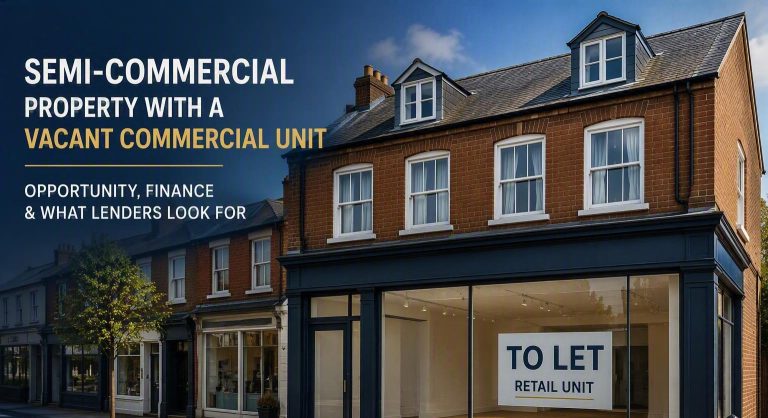
- The commercial unit is vacant
- The tenant type is considered higher risk
- The business model appears unstable
- There is limited demand for the commercial use locally
Some lenders also restrict certain business sectors entirely, while others take a more flexible view depending on the wider property profile.
.
Value Splits and Property Assessment
Semi-commercial mortgage providers can assess mixed-use properties in different ways.
Some lenders focus on:
- The value split between the residential and commercial elements
- Floor area proportions
- Rental income split between the different uses
This can become important where the commercial element forms a large percentage of the overall property value or income.
For example, one lender may class a property as semi-commercial based on floor area, while another may focus more heavily on rental income or valuation proportions.
Understanding how individual lenders assess these splits can make a significant difference to available finance options and interest rates.
.
Licensing and Planning Considerations
Planning and licensing can also impact lender decisions.
Lenders will want reassurance that:
- The property has the correct planning use
- Residential units comply with relevant regulations
- Licensing requirements are in place where needed
- Any conversions have appropriate permissions and sign-off
Properties with unclear planning history, missing approvals, or licensing concerns may limit the number of lenders willing to proceed.
.
Access Issues and Non-Standard Arrangements
Some semi-commercial properties involve more unusual layouts or access arrangements which can affect lender appetite.
Examples may include:
- Shared rear access
- Access through commercial premises
- Non-standard construction
- Complicated title arrangements
While these situations are not always problematic, they can narrow the pool of available lenders.
.
Insurance and Ongoing Costs
Mixed-use buildings can sometimes attract higher insurance premiums than standard residential investments.
This is particularly true where:
- There are higher-risk commercial tenants
- The building has multiple uses
- The property involves hospitality or food businesses
Lenders may factor these ongoing costs into affordability and risk assessments.
.
Commercial Lease Structures
Commercial lease arrangements can also influence lender decisions.
Some lenders prefer to see separate agreements for the residential and commercial elements, while others may accept a single lease covering the entire property.
Minimum lease terms can also vary significantly between providers. Some lenders may require a minimum unexpired lease term of several years, while others have greater flexibility.
.
Why Specialist Broker Advice Matters
Because semi-commercial mortgage criteria can vary so widely, identifying the right lender from the outset is extremely important.
A specialist broker like Advocate Finance can help:
- Identify lenders whose criteria suit the property
- Avoid unnecessary declined applications
- Structure the case appropriately
- Improve efficiency during underwriting
- Access specialist mixed-use lenders not always available directly to the public
.
Final Thoughts
Semi-commercial lending is a specialist area of the mortgage market, and lender appetite can differ significantly depending on the property type, tenant profile, lease structure, and commercial usage.
While some properties may be declined by certain lenders, this does not necessarily mean finance is unavailable. Understanding how different semi-commercial mortgage providers assess risk is often the key to securing a suitable lending solution.
We provide a FREE assessment on all our services.
Please contact us directly for more information, or use the Get in Touch With Us Today feature at the bottom of this page.